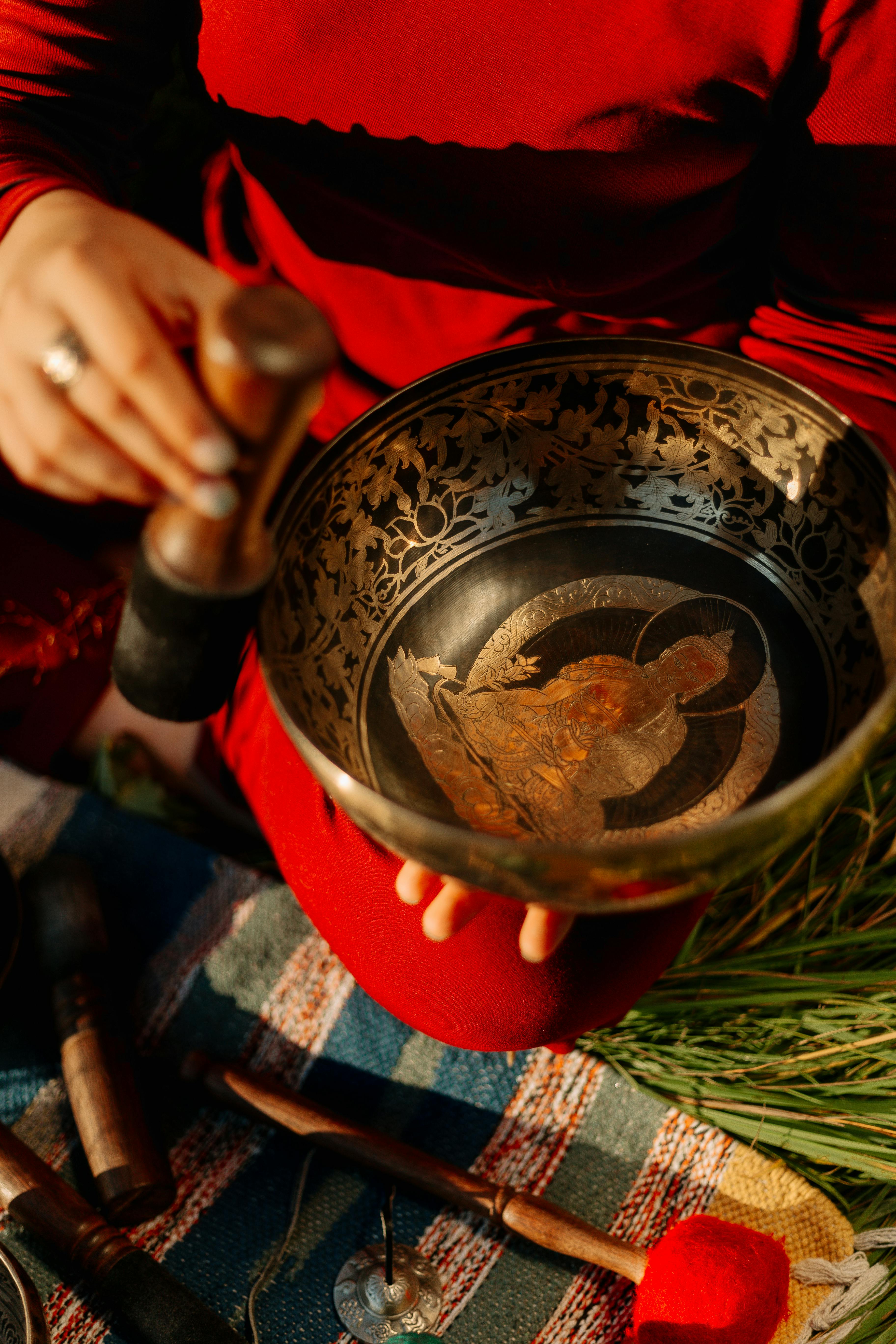
Every singing bowl produces an individual sound. Not merely "a little different" from its neighbor — fundamentally unique, the way a human voice is unique. Two bowls of the same size, weight, and apparent age can sit side by side on a shelf and respond to the same mallet in utterly different ways. This is not a flaw in the selection process. It is the starting point.

You Don't Need Technical Knowledge
Many people hesitate before buying a bowl because they feel they should understand metallurgy, recognize antique patinas, or decode Tibetan inscriptions. Jansen's message is reassuring: none of that is required. A bowl does not need special markings to be meaningful. What matters is the felt response when you play it — the subtle "yes" or "not now" that arises in your body before your mind has time to construct an argument.
Don't Let the Seller Choose for You
A knowledgeable shopkeeper can describe provenance, demonstrate technique, and narrow the field. But the final decision should never be outsourced. Sellers have their own preferences, their own sense of which bowl "should" suit a customer. You are the one who will live with this instrument, play it on difficult mornings, and fall asleep to its fading tone. Your intuition — quiet, physical, sometimes wordless — is more reliable than any expert opinion in that moment.
Each Person Vibrates at Their Own Frequency
The idea that one bowl is universally "better" than another dissolves when you consider that each person carries a distinct energetic signature. A bowl that feels overwhelming to one player may feel like coming home to another. Age, hearing ability, emotional state, and even the time of day can shift your response. This is why a bowl that rejected you last year might welcome you warmly today — and why there is no shame in walking away.
Sound Beyond Hearing
Jansen notes that even people with significant hearing loss can enjoy singing bowls through tactile vibration. Pressed against the sternum, held against the back, or rested on the abdomen, a bowl communicates through bone conduction and the ripple of resonance through tissue. The experience is not lesser for lacking a full auditory component; it is simply different. Sound healing, in this sense, was never only about the ears.
The Sacrificial Bowl
Among the most intriguing objects in the tradition are so-called sacrificial bowls — thick, heavy vessels that may never produce a singing tone no matter how skillfully you rim them. They were not made to perform. Instead, they carry a wave pattern pressed into the metal, a frozen ripple that maps how sound once moved across their surface. They remind us that not every bowl is meant to be played in the ordinary sense. Some are objects of contemplation, their "music" visible rather than audible.
An Inner Journey, Not a Shopping Trip
Choosing a singing bowl is less a transaction than a threshold. You are not acquiring decoration; you are opening a door to a practice that unfolds over months and years. Trust the bowl that stops you mid-step. Trust the silence after its tone fades. Trust the discomfort that tells you to keep looking.
The right bowl does not prove you are spiritual enough, wealthy enough, or educated enough. It simply says: I am here, and so are you. That is always enough to begin.